New York License Plate options include standard passenger plates, personalized combinations, custom picture designs, motorcycle and commercial series, and specialty plates tied to a cause, region, or profession. Vehicle owners review available designs, eligibility rules, display requirements, and registration costs before choosing an option. Fees shift with vehicle class, registration term, plate design, and the number of transactions involved.
New York license plate fees and requirements vary with the vehicle category, plate design, and registration circumstances. Drivers often look for information about standard plates, specialty designs, personalized combinations, replacement charges, and renewal expenses in one place. This page brings together New York license plate categories, costs, registration rules, replacement and surrender procedures, and common questions, so motorists can find details for passenger vehicles, motorcycles, trailers, and other registered vehicles across the state.
New York License Plate at a Glance
The facts below summarize what most drivers need before a DMV visit: who issues the plate, the format on the road, the number of plates your vehicle must carry, and the fee attached to each step. Amounts come from published DMV schedules, and the registration term and mounting height apply across plate classes.
How to Get a New York License Plate
The five steps below follow the order a DMV clerk works through, and each one has a document behind it. Missing paperwork is the most common reason a registration visit ends without plates, so collect the ownership document and your insurance proof before you travel.
-
Confirm your insurance is active
New York requires continuous liability coverage for every registered vehicle. Bring your insurance card, or the electronic ID your insurer provides, and make sure the card names the exact vehicle and shows valid policy dates.
-
Collect proof of ownership
Use the New York title for a used vehicle, or the Manufacturer’s Certificate of Origin for a new one. An out-of-state title needs a DMV review before registration moves forward.
-
Complete form MV-82
Form MV-82 is the Vehicle Registration/Title Application, and it covers both the registration and the title in one document. Use MV-82ITP for an in-transit permit and MV-82TON when the job is a title only.
-
Visit a DMV office or an approved agent
Bring photo ID and payment for the registration fee, the plate fee, and any title fee. Registered agents can process a registration for a service charge, and dealers often handle the first set of plates when you buy from a franchised lot.
-
Mount both plates and display the sticker
Attach the front and rear plates between 12 and 48 inches from the ground, firmly enough that they cannot swing, and place the registration sticker where the DMV indicates. The forms involved are MV-82, MV-82ITP, MV-78B, PD-7, and CP-30.
- New York DMV vehicle registration steps:
- dmv.ny.gov/registration/register-vehicle
- New York DMV forms, including MV-82, MV-82ITP, and MV-82TON:
- dmv.ny.gov/forms
Types of New York License Plates
New York State issues plates by registration class, so the type you receive depends on the vehicle you register and the design you request. A passenger car takes the standard series when no specialty design is ordered, a motorcycle draws from a shorter series, and a commercial truck or trailer follows its own class. Eligibility rules sit on top of that, since some designs are open to any registrant and others ask for proof of service or a professional license. The six groups below cover every plate the DMV issues.
Standard Excelsior Plates
Blue lettering on a white background, with Niagara Falls, the Adirondacks, the New York City skyline, and the Statue of Liberty. Issued since April 2020, the Excelsior series carries the state motto at the bottom, and every registered passenger vehicle receives this design when no other one is ordered.
Personalized and Vanity Plates
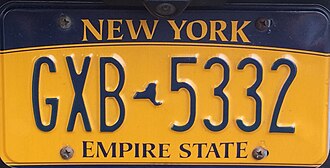
These keep the standard design and change the characters printed on it. Combinations run from two to six characters, spaces are allowed and counted, and a single state outline can be inserted on passenger plates. The DMV holds three-letter-four-number patterns for standard issue and reviews each request. An added yearly fee applies.
Custom Picture and Regional Plates
Picture plates carry a logo or image in place of plain artwork, and more than 200 designs exist across causes, charities, sports teams, colleges, and regions. Regional designs cover New York City, Long Island, the Adirondacks, and the Capital Region. Some accept a personalized number for a higher fee.
Professional, Organization and Cause Plates
Reserved for verified groups such as physicians, nurses, volunteer firefighters, emergency medical workers, unions, and charities. Proof of credential or membership goes to the Custom Plates Unit before the plate ships, and the registration must sit in the qualified person’s name. Several cause designs route part of the yearly fee to a state fund.
Military, Veteran and Disability Plates
More than 50 designs honor service branches, Purple Heart recipients, and Gold Star families, and each one requires a DD-214 or an equivalent certificate of service. Disability plates carry the ISA wheelchair symbol for qualifying registrants, with a medical certification attached. Both groups keep the plate tied to the qualifying person.
Historical, Motorcycle, Commercial and Trailer Plates
Historical plates serve vehicles at least 25 years old, with travel limited to exhibitions, parades, and test runs. Motorcycles carry a single smaller rear plate, and trucks, trailers, and business fleets fall into weight-based commercial classes with their own fee scales. In-transit permits use form MV-82ITP before permanent plates arrive.
How New York License Plate Numbers Work
Every New York plate carries a unique registration number that links the metal on the bumper to a record in the state database. The standard passenger series uses three letters followed by four numbers, written as ABC-1234, and the state issues those combinations in sequence as registrations come in. Three-letter-four-number patterns are held for state issue, so they cannot be requested as a personalized plate.
What the Characters Mean
Letters and numbers identify the registration, and a small state outline can appear as a separator on some series. Motorcycle plates use a shorter combination, and commercial vehicles follow a sequence tied to the registration class. Older series still appear on the road, since a plate stays valid until the registration expires, and a revalidation sticker marks each renewal.
Reserved and Prohibited Combinations
The DMV keeps several patterns out of circulation. Three letters followed by four numbers, and five numbers followed by two letters, are held for standard issue. The department reviews requested combinations and may decline one that reads as offensive, misleading, or confusing to a plate reader. A refusal is not a rejection of the applicant, and a second choice can be submitted at no added charge.
Why Format Matters at a Toll or Camera
Plate readers and toll systems rely on characters being clear. A bent plate, a peeling coating, or a frame that covers an edge can stop a camera from reading the number, which leads to a violation notice even when the driver did nothing wrong. Keeping the surface flat, clean, and free of covers protects the number and the registration record behind it.
What a New York License Plate Costs
Plate charges split into a one-time purchase and a recurring renewal, and the renewal sits on top of the registration bill rather than replacing it, billed every two years. A standard passenger plate is the cheapest option, personalization adds a yearly charge, and a custom picture plate carries both a higher purchase price and a higher renewal. Vehicle class drives the largest part of the bill, since a motorcycle, a passenger car, a trailer, and a heavy commercial truck each fall into a different registration class with its own fee scale, and weight-based classes cost more to renew. Sales tax applies on a first registration in New York, a title fee is added when a new certificate of title is issued alongside the plates, and a first registration usually bundles four charges, so confirm current amounts with the DMV and ask the clerk for an itemized total.
| Plate type | Initial | Annual renewal |
|---|---|---|
| Standard passenger | $25.00 | $25.00 |
| Personalized number (added fee) | $31.25 – $62.50 | $31.25 – $62.50 |
| Custom picture plate, assigned number | $60.00 | $31.25 |
| Custom picture plate, personalized number | $91.25 | $62.50 |
| Replacement plate | $25.00 | — |
| In-transit permit | $12.50 | — |
Personalized and Custom Plates
A personalized plate changes the number on a plate you already qualify for: you pick the characters, the DMV checks the combination, and the plate arrives with your choice printed on it. Three letters followed by four numbers is reserved for the standard series, so a request such as ABC1234 will be refused, spaces count toward the limit, and a single state image can be placed anywhere except the first or last position. A custom plate changes the design instead, adding a picture, logo, or slogan from a catalog of more than 200 options, and some designs require proof of membership, a professional license, or military service. Orders go through the DMV online transaction, by phone, by mail with form CP-30, or at an office, and it pays to check availability first, since the same personalized plate lookup reports whether a combination is free before an application goes in.
How a New York License Plate Lookup Works
A plate lookup takes the number printed on a bumper and returns vehicle-level details, which can include the make, model, model year, trim, engine, plate class, registration status, and any open safety recalls. Buyers use it before a private sale, and drivers use it to confirm that a plate they were issued is recorded correctly. One boundary applies everywhere: registered owner names, home addresses, phone numbers, and driving records are protected under the federal Driver’s Privacy Protection Act, so no public lookup returns them, and permitted users such as law enforcement, insurers, and licensed private investigators file a certified request with the DMV to reach that material. New York blocks plate lookups from being used to trace people, so if a vehicle worries you, report it to local police rather than trying to identify the driver yourself, and treat any site that promises an owner’s address as unreliable.
Renewing a New York Registration and Plate
New York registrations run for two years and then renew, either online, by mail, or at an office, with the registration fee plus any custom plate renewal that sits alongside it. Inspection must be current before a renewal clears, the vehicle needs active insurance for the full term, and a renewal notice arrives roughly 45 days before the expiry date. Plates older than ten years can be replaced during renewal, since the DMV runs a ten-year replacement cycle to keep reflective coating readable for toll cameras and plate readers, and peeling or delaminating plates qualify for a free exchange. Miss the deadline and the registration becomes suspended, which risks a summons and costs more to reinstate than renewing on time, so set the renewal date the day the notice arrives.
Replacing, Surrendering and Storing Plates
Lost or stolen plates are replaced for $25, and if plates were taken in a crime, a police agency completes form MV-78B, which supports a free replacement; bring identification and the registration certificate to an office, and keep a copy of the police report in the vehicle until the new set arrives. When a registration ends, the plates must come off the road, so surrender them with form PD-7 at an office or mail them to the address printed on the form, and keep the receipt as proof for your insurer. If you prefer not to mail plates, cut them into pieces and recycle the metal once the registration is cancelled, and never pass plates to another driver or display them on a vehicle they were not issued to, since both actions carry penalties.
New York License Plate Design History
New York has redesigned its plate several times since 1901, and each change reflects the technology of the period, from hand-lettered boards to digitally printed metal with reflective coating.
- 1901–1909 — Registrants made their own plates in black and white, displaying their initials, and the state issued nothing.
- 1910 — New York manufactured its first state plate, valid inside the state only, and serial numbers replaced owner initials.
- 1956 — The 6 by 12 inch size arrived with uniform mounting holes, settling plate dimensions across the country.
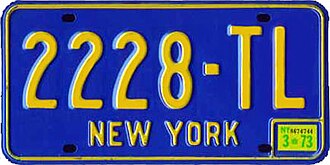
- 1973–1980 — Dark blue serials on reflective orange plates, revalidated each year with a windshield sticker.
- 2001–2010 — A blue and white design carrying the slogan The Empire State, with Niagara Falls and the skyline along the top.
- 2010–2020 — Empire Gold, pairing navy lettering with a gold background, and free exchanges for peeling runs.
- 2020–today — Excelsior, chosen in a public vote in 2019, with state landmarks and the motto printed in gold.
New York Plate Laws You Should Know
Section 402 requires a distinctive number and a matching set of plates, one at the front and one at the rear, fastened so they cannot swing, kept clean and readable, and mounted between 12 and 48 inches from the ground, with a toll transponder the only item allowed to sit over a plate. The same section bans covers, and since September 2024 glass, plastic, and any material that hides or distorts a plate image are unlawful, with fines from $100 to $500; selling a cover built to obscure a plate is a separate violation that can lead to a registration suspension. Section 402-A bans decorative and facsimile plates that match a DMV plate in size, shape, color, and design, with a civil penalty up to $500 per violation, so a novelty plate for the garage wall cannot go on a registered vehicle.
Frequently Asked Questions
These answers cover the questions drivers ask most often about New York license plates: what a plate costs, how to order a personalized or custom design, what to do when a plate is lost or stolen, and how plates must be mounted. Each answer follows the rules published by the Department of Motor Vehicles, so you can confirm the details before you order or renew.
How Much Does a New York License Plate Cost to Buy or Replace?
A standard passenger plate costs $25 with a $25 renewal, and a replacement for a lost, stolen, or damaged plate costs $25. A custom picture plate with an assigned number runs $60 initially with a $31.25 yearly renewal, and adding a personalized number raises that to $91.25 initially and $62.50 yearly. Personalization on a standard plate carries its own yearly charge between $31.25 and $62.50, billed every two years alongside the registration.
Can You Look Up the Owner of a New York License Plate?
No. Owner names, home addresses, phone numbers, and driving records are protected under the federal Driver’s Privacy Protection Act and are not released through any public lookup. A plate lookup returns vehicle-level details such as make, model, model year, trim, and open recalls. Law enforcement, insurers, and licensed investigators file a certified request with the DMV to reach owner records.
How Do You Get a Custom or Personalized New York License Plate?
Check availability first through the DMV personalized plate lookup, then order online, by phone, by mail with form CP-30, or at an office. Personalized plates change the characters on a standard design and allow two to six characters, with spaces counted. Custom picture plates change the artwork instead and draw on a catalog of more than 200 designs, some of which need proof of membership or a professional license.
What Should You Do If a New York License Plate Is Lost, Stolen, or Peeling?
Report a stolen plate to police and have them complete form MV-78B, which supports a free replacement. A lost or damaged plate is replaced for $25 with identification and the registration certificate. A plate with peeling or delaminating coating qualifies for a free exchange at a DMV office, and the state runs a ten-year replacement cycle to keep reflective coating readable.
Do You Need a Front License Plate in New York, and How Must It Be Mounted?
Yes, almost every passenger and commercial vehicle needs a plate at the front and another at the rear. Both must sit between 12 and 48 inches from the ground and stay fastened so they cannot swing. Motorcycles and certain trailers carry a single rear plate. Glass, plastic, and any coating that hides or distorts the number are unlawful, with fines running from $100 to $500.