NY vanity plates let a driver replace the number the DMV would assign with a combination of their own, printed on the standard series or on a custom design. Personalization runs from two to six characters, spaces count toward that limit, and a single state outline can be inserted in most positions. since the state holds certain patterns for standard issue, the combination has to clear a review before the plate is made, and the personalization charge repeats with every renewal.
This page covers the character rules, the review process, the current fees, and the way a chosen number pairs with a picture plate. It follows the same order the DMV uses, so a driver can check availability, place the order, and know what the two-year bill will look like before committing to a combination.
NY Vanity Plates at a Glance
The points below cover who can order a personalized plate, how the number is chosen, and what it costs to keep it on the road.
How to Order a Vanity Plate
A personalized plate is an add-on to an existing registration, so the order only moves forward when the registration itself is in good standing. The sequence below follows the order the DMV transaction asks for the information.
-
Check the combination is available
Run the DMV personalized plate lookup before anything else, since a combination already on the road cannot be issued again. The check is free, it can be repeated as often as needed, and it reports whether the number is free on the design you want rather than on the standard series alone.
-
Confirm the registration is current
The registration must be active and must not expire within 60 days of the order. Renew it first when the expiry date sits inside that window, and make sure the name and address on record match your documents, since the plate is mailed to the address on file.
-
Choose the design
A chosen number can sit on the standard series or on a picture plate from the catalog. The design decides the purchase price, and a few designs cannot be personalized at all, so read the plate’s own page before selecting it.
-
Enter the characters
Type the combination exactly as it should appear. Spaces count as characters, the state outline marker occupies one position, and punctuation other than that marker is not accepted. Two to six characters is the working range for passenger plates.
-
Order and pay
Complete the order online, by phone, by mail with form CP-30, or at a DMV office. The purchase charge is paid at the time of ordering, and the personalization charge joins the registration bill at renewal.
-
Swap the plates when they arrive
New registration documents follow within about ten days, and the plates themselves take eight to ten weeks. Drive on the old plates until the new set arrives, then remove the old plates and destroy them so they cannot be reused.
- Personalized plate rules and ordering:
- dmv.ny.gov/plates/personalized-plates
- Personalized plate availability transaction:
- transact3.dmv.ny.gov/platespersonalized
Character Rules and Combinations
The DMV accepts letters and numbers plus spaces, and it counts every position toward the limit. A space used to group a phrase, as in GO 4 IT, takes a slot of its own, which is why a shorter phrase often reads better on a plate than a crowded one. Punctuation is not accepted at all, and the state outline described below is the only symbol allowed.
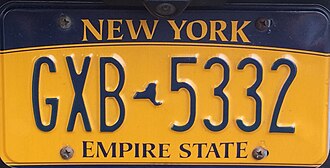
Three letters followed by four numbers, and five numbers followed by two letters, are held back for standard issue, so ABC1234 and 12345AB are refused even when nothing else about them is objectionable. The state outline can be placed anywhere except the first and the last position, and it costs one character from the total. Passenger and commercial plates with seven or fewer characters are the designs that accept it.
What Happens When a Combination Is Refused
A refusal is a decision about the combination, not about the driver. The DMV reviews each request and may decline one that reads as offensive, misleading, or hard for a camera or a person to interpret at a glance. A second choice can be submitted at no added charge, and a refund applies when the plate cannot be issued at all.
Spaces and the Way a Number Is Read
A space takes a character slot, so a gap that makes a phrase easier to read shortens the phrase itself. GO 4 IT uses seven positions once the spaces are counted, which is why the same idea with fewer words often fits better. A driver who wants a longer phrase sometimes drops a space and relies on the shapes of the letters to separate the words, though that can make the plate harder to read at a distance.
How the State Image Works
A small blue outline of New York State can be inserted into a personalized number, and it behaves like one character. It cannot occupy the first or the last slot, only one may appear on a plate, and it is available on passenger and commercial plates with seven or fewer characters including spaces. Drivers use it to break up a run of letters or to separate two words without spending a space, which matters when the combination is already at the limit.
When the Outline Is Not Available
The outline is not offered on every plate. It appears on passenger and commercial designs with seven or fewer characters, and it is left off motorcycle plates and most specialty designs. When a combination already uses the full character count, adding the outline would push it over the limit, so a letter or a number has to come out. Checking the design page first shows whether the symbol can be used at all.
Choosing a Combination That Reads Well
Personalized numbers are read at a distance, often at an angle, and sometimes by a camera rather than a person. Combinations that rely on a subtle letter substitution, such as a zero standing in for an O, are the ones most often mistaken for a different number, which can create problems with toll billing and enforcement. Words written with a gap tend to read better than words written without one, though the gap consumes a character. A short phrase usually works better than a string of initials, since initials carry meaning only to the owner and read as noise to everyone else. The safest choices spell something a stranger can read on the first pass.
Combinations to Avoid
Anything that resembles an official series is refused by policy, and anything that reads as a government mark is refused on the same grounds. Numbers that imitate a police, fire, or government designation are declined, and a combination that could be mistaken for a dealer or transporter plate falls into the same category. The availability check does not screen for these issues, so a number can appear free and still be declined at review.
Letters and Numbers That Look Alike
A zero and a letter O, a one and a letter I, and a five and a letter S are the pairs most often confused. A combination built around one of those swaps may read correctly to its owner and wrongly to a toll camera or an officer. The DMV may decline a request when the substitution makes the plate hard to interpret, and a number that has already caused a billing problem is a poor choice for a new plate.
What a Vanity Plate Costs
The personalization charge is separate from the plate purchase, and both repeat. The table below shows the published levels, with the renewal column showing the figure that joins the registration bill every two years.
| Option | Initial | Annual renewal |
|---|---|---|
| Personalized number on a standard plate | $31.25 – $62.50 | $31.25 – $62.50 |
| Custom picture plate, assigned number | $60.00 | $31.25 |
| Custom picture plate, personalized number | $91.25 | $62.50 |
| Replacement of a personalized plate | $25.00 | — |
| Standard plate, no personalization | $25.00 | $25.00 |
The DMV bills the personalization charge every two years alongside the registration renewal, so a two-year bill combines the registration fee, the plate charge, and the personalization figure. Replacing a personalized plate costs the same $25 as any other replacement, and the chosen number is reissued with the new set. Dropping the personalization at renewal returns the plate to the standard charge.
Vanity Plates on Specialty Designs
A chosen number can be printed on many picture plates, including sports, college, regional, and cause designs, for a higher fee than the same number on the standard series. Professional plates follow a different path, since eligibility has to be proved before the design is produced, and a few designs are issued only with an assigned number. When a design cannot be personalized, the DMV states it on the plate’s own page, and the order form will not offer the choice.
Paying for a Personalized Number Over Time
The purchase price is paid once, and the personalization charge returns with every registration cycle. A driver who keeps a vehicle for ten years pays the yearly figure five times across five two-year terms, so the running total of a chosen number grows well past the amount paid at the start. Comparing two combinations on the renewal line rather than the purchase line shows the true difference between them. A two-year bill that already carries a custom design and a chosen number stacks the personalization charge on top of the design renewal, so the plate line can reach the top of the published range. Weighing a picture plate against a plain standard plate with a chosen number makes sense on the two-year totals rather than on the single figures quoted at purchase.
Transferring a Vanity Plate to Another Vehicle
Plates move with a registration rather than with a driver, so a personalized set can follow its owner from one vehicle to another when both are registered in the same name. The transfer is completed with form MV-82 at a DMV office, and the plates must be in displayable condition, with no peeling coating and no damage to the number. When a vehicle is sold, the plates come off it, and they cannot be handed to the buyer even when the buyer would like to keep the number.
Vanity Plates for Motorcycles and Commercial Vehicles
Motorcycle plates can be personalized within a shorter character limit and are issued as a single rear plate. Commercial plates accept personalization for some series but not all, since the registration class restricts which designs are available. Trailers use their own series and a shorter combination, and a personalized number ordered for the wrong class will be refused rather than produced. Checking the class printed on the registration certificate before ordering avoids that outcome.
What Happens When the Registration Lapses
A personalized number is tied to an active registration, and the combination returns to the pool once that registration ends and is not renewed. Reinstating a lapsed registration can restore the plate in some cases, but the state is not obliged to hold the number for as long as the record is suspended. A driver who wants to keep the characters should renew before the expiration date rather than wait for a notice.
Common Reasons a Vanity Order Is Delayed
A personalized order moves through two reviews, and either one can send it back to the driver. The first check looks at the combination against the reserved patterns and the policy on offensive or misleading text. The second looks at the registration, the design you selected, and the payment attached to the order. Most delays trace back to a detail that was easy to overlook when the application went in.
A Combination That Fails Policy Review
Some numbers pass the free availability check and still fail the review. The lookup reports whether a combination is already on the road, not whether the state will permit it. A number that resembles a police, fire, or government tag, or one that reads as a slur or a threat, is refused on policy grounds no matter how available it is. Sending a backup choice with the first application shortens the wait when the opening pick is turned down. A driver who wants a phrase tied to a name or a hobby should test it against the reserved patterns before ordering, and a combination built from ordinary words is usually safer than one that leans on an inside joke. Reviewers weigh how the letters read at highway speed, where an odd split can turn a harmless word into something else.
An Expiring or Stale Registration
The registration behind the plate has to be active, and the DMV will not process an order when the expiry date sits within 60 days. A registration that has already lapsed has to be reinstated first, which adds its own cost and delay. The name and address on the record have to match the application as well, since the plate is mailed to the address on file and a mismatch stops the order before production begins. An address change takes a separate form and should be filed before the plate is ordered, since mail sent to an old address is returned to the state and the plate is held until a current address is on file.
Proof That Does Not Match the Design
A professional or organization design needs documents that line up with the plate being requested. A license copy with an expired date, a letter that uses a shortened form of the sponsor’s name, or a membership card issued to someone other than the registrant will each hold up the order. Matching the paperwork to the registration record before it goes in prevents a round trip through the Custom Plates Unit.
Keeping a Vanity Number in Good Standing
A personalized number stays with the registration, and the registration has to stay active for the number to remain on the road. The DMV prints the combination on the certificate, matches it to the sticker that carries the term, and quotes the personalization charge against the same record at renewal. Drivers who plan to keep a chosen number for years should treat the renewal date as the date that protects it, since a lapsed registration releases the combination to the pool.
Matching the Combination to the Vehicle
A personalized plate is issued for one registration and one class. Moving the set to another car you own takes form MV-82 and a transfer handled at a DMV office, and the plate has to be in displayable condition with no damaged coating. A set cannot move to a vehicle registered in another person’s name, and it cannot go to a buyer when the car is sold. A motorcycle or trailer series carries its own shorter combination, so a number chosen for a passenger car does not follow the driver to those classes.
Swapping Between Designs
A chosen number can be reprinted on a different design when the driver wants a new look. The DMV treats that as a new plate order, so the design purchase price applies again and the personalization charge continues. The number itself is held during the swap so another driver cannot take it. A driver who only wants plainer artwork can drop the design at renewal and keep the same characters on the standard series.
Renewal, Insurance and Inspection
The renewal clears only when inspection is current and insurance covers the full two-year term. A lapsed policy stops the renewal even when the money is ready, and it can leave the personalized number exposed. Settling the policy and the inspection before the renewal date keeps the plate valid and the combination out of the pool. A driver who moves out of state should surrender the set rather than let the registration lapse from a distance.
Frequently Asked Questions
These answers cover what drivers ask most often about personalized plates, from the character limit and the fee to refusals and replacements.
How Many Characters Can a NY Vanity Plate Have?
Between two and six characters on most passenger plates. Letters, numbers, and spaces are accepted, and each space counts toward the limit. A single state outline may be inserted as one character on passenger and commercial plates of seven characters or fewer, and it cannot sit in the first or last position.
How Much Extra Does a Vanity Plate Cost in New York?
The personalization charge runs from $31.25 to $62.50 each year, and it is billed every two years with the registration renewal. On a custom picture plate, personalizing the number raises the purchase price to $91.25 and the yearly figure to $62.50, both on top of the registration fee.
Can the DMV Refuse a Requested Combination?
Yes. The DMV reviews every request and is not obliged to issue it, so a combination that reads as offensive, misleading, or confusing to a plate reader can be declined. Patterns reserved for standard issue, such as three letters followed by four numbers, are refused as a matter of policy.
How Do I Check Whether a Plate Number Is Available?
Use the DMV personalized plate lookup, which asks for the design and the combination, then reports whether it is free. The check costs nothing and can be repeated as often as needed, which avoids submitting an application for a number already on another vehicle.
What Happens to My Vanity Plate If It Is Lost or Stolen?
A personalized plate is replaced for $25, the same as a standard plate, and the chosen number is reissued with the new set. A stolen plate should be reported to police so form MV-78B can be completed, which supports a free replacement in that situation.