New York has changed the color of its standard plate several times, and each switch left a different generation on the road at the same time. The state’s official colors are gold and blue, and most of the modern designs return to that pairing in one form or another. Drivers see orange plates from the 1970s, white and blue plates from the 1980s and the 2000s, gold plates from 2010, and the current white Excelsior plates. Color is not decoration alone: it decides how well a plate reads at night, in rain, and on a toll camera.
The DMV does not recall every plate when a new color arrives. A plate stays valid as long as the registration behind it is current, so a driver can renew an orange plate from 1974 or a blue and white plate from 2005 without any problem. Replacement happens when the plate wears out, when the car changes owners, or when a driver chooses to pay for the newer design. That mix of generations is why a single parking lot in Buffalo can hold five different color schemes on the same afternoon.
How New York Plate Colors Changed
Reflective sheeting is the main reason the surface changed. Before the 1970s, plates were plain painted metal, and the state could pick any background it liked. Once engineers began bonding a reflective film over the steel, the film itself set the rules: a light background with dark characters bounces light back toward a headlight, and a dark background swallows it. Gold, white, and orange all reflect well, which is why they keep returning. Cost pushed changes too. A statewide reissue is expensive and unpopular, so the state now waits about a decade before it switches a base.
A Color Timeline of New York Plates
Each base below carried a different slogan, a different background, and a different graphic, and the DMV still accepts several of them on the road today. A driver who wants to know which one sits on their car should read the slogan line first, since that single word or phrase separates the generations more cleanly than the color alone does.
| Years | Background and characters | Slogan and graphic |
|---|---|---|
| 1973 to 1980 | Dark blue on reflective orange | No slogan, state outline as the divider |
| 1986 to 2001 | Dark blue on white with red stripes | A red Statue of Liberty in the center |
| 2001 to 2010 | Dark blue on white with blue bars | The Empire State over a state skyline |
| 2010 to 2020 | Gold field with a dark blue banner | Empire State beside a state silhouette |
| 2020 to today | White with dark blue characters | Excelsior in gold with a blue outline |
The table shows one pattern: the state alternates between a white base and a gold or orange base roughly every decade. Each change resets the plate numbering series, so a combination issued on one base does not appear on the next. Drivers who prefer an older look can usually keep the plate they have, and the DMV does not force a swap on a car that is already registered.
Why the State Switches a Design
A base is replaced for three reasons: the reflective film wears out across the fleet, a new printing method lowers the cost, and the state wants a fresh look after years of one design. Cost matters, since reissuing plates for millions of cars is a large public expense. A full reissue happens rarely, and the state learned from the Empire Gold launch that drivers resist paying for a swap they did not ask for. A new base now rolls out as older plates wear out or change owners.
How a New Design Is Chosen
The Excelsior base came out of a statewide vote in 2019, and the DMV turned the winning entry into a production plate in 2020. A public contest lets the state gather artwork without paying a design firm, and it builds interest in the result. Officials still apply the same legibility tests to any winning entry, so a busy sketch can be adjusted before it is printed. Corcraft then cuts and embosses the steel at Auburn Correctional Facility.
New York Plate Colors Through the Years
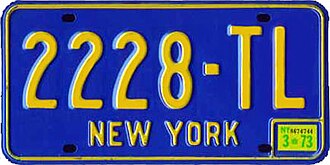
The orange plate arrived in 1973 and stayed in service well into the 1980s. It used dark blue characters on a reflective orange field, with the state outline standing in as the divider between the letters and the numbers. Orange was a deliberate choice: the state’s heritage colors are blue and gold, and the reflective orange read as a warm gold under a headlight, keeping the blue characters dark and sharp. Plates from this family remain legal on the road when the registration is current, and collectors treat clean examples as a marker of that decade.
Blue and White Plates from 2001 to 2010
Between January 2001 and March 2010, the standard passenger plate was white with blue bars above and below the number. The upper bar carried the state name in white over a band of artwork showing Niagara Falls, the Adirondack Mountains, and the New York City skyline, and the lower bar carried the words The Empire State. That base was the first to bring the slogan back since 1963. It is often called the Empire Blue and White plate, and it stays valid today, long after the DMV stopped issuing it in 2010.
Empire Gold and the Years from 2010
The Empire Gold plate arrived on April 1, 2010, and it returned to the blue on gold pairing the state had used on the orange base. A dark blue banner runs across the top with New York printed in gold, the number sits in dark blue over a gold field, a small dark blue state silhouette divides the letters from the numbers, and Empire State appears in dark blue along the bottom edge. The state first planned to replace every older plate within two years, then dropped the mandatory swap after drivers objected to the charge.
The White Excelsior Design in Use Today
The current plate took its look from a statewide vote held in 2019, and the DMV began issuing it in 2020. It puts dark blue characters on a white field, sets the state name in dark blue across the top between gold and blue stripes, and places a gold Excelsior at the bottom center with a blue outline. Niagara Falls and the New York City skyline appear along the lower edge, and the state motto replaced the Empire State nickname. The DMV stopped issuing Empire Gold plates once the new base took over.
Color, Legibility and Wear
A modern plate is a piece of steel covered with a thin sheet of reflective film, and that film does the work of throwing a headlight beam back toward the driver who sent it. The film is rated for a set number of years, and the state has said the reflectivity of a plate is guaranteed for only about five years of normal use. Characters are embossed and then inked, so a light background with dark letters produces the strongest contrast. A plate that has lost its sheen reads poorly at night, which is the main reason the state reissues a base about every ten years.
Faded, Peeling and Delaminating Color
The most common failure on a New York plate is not rust but peeling. The reflective film separates from the steel, and the surface lifts in sheets around the embossed characters. It shows up first along the numbers and the edges, and it worsens with every winter of road salt. Some runs of the Empire Gold base peeled faster than the state expected, and the DMV set up a free exchange for plates that failed early. A peeling plate can draw a traffic stop, since an unreadable plate gives an officer a lawful reason to pull a car over.
A driver with a damaged plate can order a replacement for $25, and the new set arrives as a clean pair with the same number in most cases. Peeling that starts within the first few years can qualify for a free replacement. Keeping the plate clean and free of cracks does more for readability than any coating, and a bent or partly obscured plate is a fixable problem rather than a permanent one.
Plate Color and Toll Cameras
Toll readers and plate-reading cameras work on contrast, and color sets that contrast. A white or gold field with dark blue characters gives the software a wide gap between the light background and the dark glyphs, which is why the current designs keep busy artwork away from the number. A plate with peeling film, a bent corner, or a frame that covers a character gives the camera a weaker image. New York runs cashless tolling on many crossings, so a plate a camera cannot read can lead to a bill mailed to the wrong owner or to an unpaid toll notice.
How to Tell Which Plate You Have
Four features separate the New York bases, and a driver can read them from a photo without any paperwork. Start with the slogan on the bottom line, then the background color, then the artwork behind the number, and finally the style of the state name across the top. The order below runs from the newest base to the oldest.
-
Read the slogan line
Excelsior in gold with a blue outline marks the current base. A white The Empire State on a blue bar points to the 2001 to 2010 plate. Empire State in dark blue on a gold field belongs to the Empire Gold years, and no slogan at all sends you back before 2001.
-
Check the background color
White points to the Liberty base, the Empire Blue and White base, or the current Excelsior design, so this step narrows rather than settles. Gold or orange sends you to a much smaller group. A dark blue on reflective orange field belongs to the 1970s and early 1980s.
-
Look at the artwork
A red Statue of Liberty in the center of a white plate with red stripes dates the plate to the 1986 to 2001 run. Niagara Falls, the Adirondacks, and a city skyline across the top mark the 2001 design. A gold and blue stripe pair beside the state name marks the base in use now.
-
Watch the state name style
Earlier plates screened NEW YORK plainly across the top in dark blue. The 2001 base set the name in white inside a blue band that carried the skyline artwork. Empire Gold printed the name in gold inside a dark blue banner, a layout no other New York base repeats.
-
Note the separator between letters and numbers
Several bases use a small map of New York as the divider between the letter group and the number group. On the 1973 orange plate the outline stands in dark blue against the orange field. Seeing that small silhouette is often faster than reading the slogan on a dirty plate.
- New York DMV plate types and designs:
- dmv.ny.gov/plates
- Registration renewal and plate replacement:
- dmv.ny.gov/plates
Specialty Designs and Their Colors
Beyond the standard series, New York prints a range of designs tied to causes, colleges, branches of service, and regions, and each one pairs its own colors. A plate for a charity may show a bright logo over a colored field, and a military plate may use a muted background so a branch emblem stands out. Some designs are open to any driver who pays the fee and any donation the group sets, and others require proof of membership or service. The colors are chosen to keep the characters dark against a light field or light against a dark one, so the number stays readable.
Cause and Organizational Plates
A cause or organizational plate carries the artwork of the group that sponsors it, along with a state-approved color scheme. The sponsor may add a yearly donation on top of the standard plate fee, and that figure varies from one group to the next. A driver who orders one of these designs should expect a longer wait than a standard issue, since the plate is made to order. The DMV reviews the artwork for contrast before it prints anything, and it turns down a design that crowds the number. A plate that names a cause still has to pass the same readability rule as a plain one.
Regional and Service Plates
Regional plates are issued to drivers who live in a set area, and the Long Island design with the Montauk Point lighthouse is the best known of them. Service plates mark a branch of the armed forces or a public safety role, and several of these designs use a subdued background so the emblem reads clearly. Each carries its own combination of colors, and a driver often picks a specialty plate for the look as much as for the cause. Confirm the eligibility rule on the plate’s own page before you order, since some designs ask for proof of residence or service.
Keeping a Plate Legible
Color does more than set a mood on a plate; it decides whether a camera or an officer can read the number. A dark figure on a light field gives the strongest contrast, and a busy image behind the characters weakens it. New York mounts the plate between 12 and 48 inches from the ground and expects the face to stay clean and whole. A frame, a bend, or a coat of film that has begun to lift all cut the contrast a reader needs. A driver can protect the reading of a plate with a few simple habits.
Frames That Obscure Characters
A decorative frame that covers the state name, a tagline, or any part of a letter can lead to a ticket, and the state bars a facsimile plate under section 402-A of the vehicle and traffic law. A frame that sits too close to the embossed characters can cast a shadow that hides an edge. Choose a frame that leaves the whole face open, and check that it does not cover the small state silhouette or the registration sticker on states that use one. New York drivers should keep the plate face itself clear of covers, since a hidden character defeats the point of a readable tag.
Cleaning Without Damaging the Film
The reflective film on a New York plate is thin, and the wrong cleaner can dull it. Wash the plate with mild soap and water, then dry it with a soft cloth. Skip abrasive pads, solvents, and any polish meant for bare metal, since those lift the film and remove the printed artwork. A bug and tar remover used on the bumper should stay away from the plate face. Road salt in winter is the worst offender, so rinse the plate when the roads are clear. A plate that has started to peel cannot be repaired, and a replacement set costs $25.
Plate Colors and the Registration Record
The color on the bumper does not change the registration behind it. A plate stays linked to the record by its number, and the number survives a change of base when the driver keeps the same tag. Only a new plate, a replacement, or a new owner resets the series. A driver who swaps a design should confirm that the number carries over, since a specialty or personalized combination follows the owner rather than the base. The state’s records in Albany track the plate and the vehicle together.
Keeping the Same Number Across a Design
A personalized combination belongs to the owner for as long as the registration stays active and renews on time. Ordering a new design does not drop the characters, so long as the request travels with the same record. A standard number can carry to a replacement set when that number is free. If a registration lapses, the combination returns to the pool and a driver who wants it back must file again and pay the yearly personalization charge.
Renewal, Replacement and a Fresh Look
A renewal keeps the plates already on the car, so a driver can hold an older color for years. A worn plate calls for a $25 replacement, and the state issues a clean set in the current base when the old series is no longer made. A driver who wants the newest look before a plate wears out can pay for a replacement and request the current design. Either way, the two-year registration cycle sets the moment to plan the change.
Frequently Asked Questions
These answers cover the questions drivers ask most often about New York plate colors, from the background of the current issue to the older bases that are still legal and the reason a plate fades or peels.
What Color Is the Current New York License Plate?
The current standard plate is the Excelsior design, issued since 2020. It has a white background with dark blue characters, the state name in dark blue across the top between gold and blue stripes, and the state motto in gold with a blue outline at the bottom center. Older gold and blue plates stay valid.
Are Old Orange New York Plates Still Valid?
Yes. A plate from the 1973 to 1980 orange series stays valid as long as the registration behind it is current, and the DMV does not require a driver to trade it in. The plate is replaced only when it wears out, when the car changes owners, or when the owner asks for a newer design.
Why Do New York Plates Peel and Fade?
The surface is a sheet of reflective film bonded to steel, and that film breaks down over time. Road salt, sun, and repeated washing lift the edges, and the film separates around the raised characters. Some runs of the Empire Gold base failed earlier than expected, and the DMV offered a free exchange for those plates.
What Color Were New York Plates in the 1970s?
The 1973 issue used dark blue characters on a reflective orange field, with the shape of New York as the divider between the letters and the numbers. The base stayed in service into the 1980s, and the state returned to the same blue on gold idea when it rolled out Empire Gold in 2010.
Can I Keep My Old Plate Color When I Renew?
In most cases, yes. A renewal keeps the plates already on the car, so an older blue and white or gold set stays in place. A new plate comes with a new registration, with a plate issuance at a DMV office, or with a paid replacement order when the owner wants the current design.