New York license plate history runs from owner-made boards in 1901 through porcelain and embossed steel to the reflective plates on the road today. The state was the first to require vehicle registration, and for the opening decade drivers produced their own plates, which is why early examples vary so widely in size, material, and lettering. Collectors date a plate by its slogan, its serial pattern, and the year stamped on it.
This page follows the designs in order, from the first state issue in 1910 to the current Excelsior series, and notes what changed at each step. It covers the year-of-manufacture rule that lets a period plate sit on a registered vehicle, since that rule links the history directly to present-day registration.
New York License Plate History at a Glance
The summary below lists the design periods and the change that defines each one.
Early Plates, 1901 to 1910
New York was the first state to require its residents to register a motor vehicle, and in the opening years the state issued no plates at all. Owners displayed their initials in black on a white background, made from metal, wood, or leather, and painted some letters directly onto the body of the car. Sizes differed, mounting points differed, and the only constant was that lettering had to stand at least three inches high.
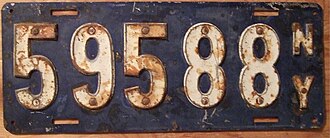
That changed in 1910, when the state began producing its own plates and replaced owner initials with a serial number. Early state plates were valid inside New York only, so a driver crossing into a neighboring state was effectively unplated, and the design stayed deliberately plain so the number could be read from a distance.
District and County-Coded Serials
Before a central database existed, the plate itself carried the geography. All-numeric serials in the earliest runs were issued in the New York City district, an A prefix belonged to the Albany district covering eastern upstate counties, and a B prefix belonged to the Buffalo district covering the west. Later runs used letter suffixes, so a serial that ended in A or AB pointed to a county rather than to a district, and collectors today read those patterns to date an example.
County coding survived in some form into the 1970s. A plate stamped with a two-letter prefix told an officer which county had issued it, which mattered when records were held on paper at a local office. When statewide records moved onto computer systems, the codes lost their purpose and the serial formats simplified.
What Owners Made Before 1910
Registration became law in 1901, and for the first nine years the state issued nothing. Owners displayed their initials in lettering at least three inches high, in black on a white background, and they built the plates themselves from whatever the workshop had on hand. Two surviving examples from the same year can differ in size, material, and mounting, which makes those early plates the hardest part of the hobby to date with confidence.
Steel, Slogans and the Standard Size
Embossed steel carried the state through the middle of the century, with the name NEW YORK spelled out along the bottom. Weight and finish varied with the metal supply, and during the war years the state reused older plates by adding a metal tab or overstamping the new year rather than pressing a fresh set. The lettering was pressed into the metal by a die, so the depth of the characters varies between runs and between manufacturers. A shallow strike can make an old plate look worn even when the finish is otherwise sound.
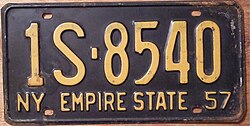
The 1956 agreement on plate dimensions settled size across the country, and New York’s 1957 issue was the first to follow it. From there the state reused the same die work for years at a time, adding a metal tab or a windshield sticker to mark the new registration year rather than stamping a completely new plate.
The 1940s and the World’s Fair Slogans
Slogans arrived before the war and returned afterwards. The 1938 and 1940 issues carried a reference to the New York World’s Fair, which turned a registration plate into a small piece of advertising for the event. That experiment showed the state that the plate could carry a message and a number, and later designs made room for a motto on a permanent basis.
The wartime years interrupted the pattern. Metal went to war production, the state reused existing plates, and new registrations were marked with tabs rather than with fresh stampings. Collectors look for a wartime plate that carries two different years, since an overstamped example records both the original issue and the year of reuse.
Tabs, Stickers and the Year on a Plate
A plate can show a year that does not match the year it was stamped. Metal tabs and windshield stickers marked each renewal term, and a stamped year referred only to the original issue. A wartime example may carry two years at once, one pressed into the metal and one added later. Collectors record both, since the pair tells how long the plate stayed in service.
Color, Revalidation and Reflection
Color arrived as a deliberate choice rather than a by-product of materials. The 1973 run placed dark blue lettering on a reflective orange field, and the plate was revalidated each year with a windshield sticker, a system the state still relies on. Reflective sheeting replaced plain enamel, which made a plate easier for a camera to read at night. The shift from enamel to reflective stock changed how a plate wears. Enamel chips from the edge inward, and reflective sheeting peels in sheets, so the two generations fail in different ways and age at different rates.
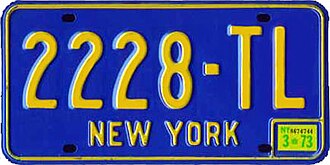
Later runs in the same period carried the state name in a bar along the top and bottom, and the serial formats shifted as combinations ran out. By the 1980s the state was printing flat plates rather than stamping them, which allowed finer graphics and made the artwork itself part of the design. Flat plates made it possible to print a design in full Color, opening the door to the specialty programs that exist today.
The Empire State and Empire Gold
The design that opened in 2001 carried the words The Empire State along the bottom, with Niagara Falls and the New York City skyline across the top. It ran for a decade and became the plate most drivers picture when they think of New York.
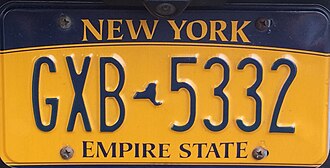
Empire Gold followed in 2010, pairing navy lettering with a gold field and a blue banner across the top. Peeling on some production runs led the state to offer free exchanges for affected plates, a problem that shaped the next redesign. The motto moved to the bottom in gold, where it has stayed since.
The Move to Flat Printing
Flat plates changed what a design could hold. Stamping raises the characters out of the metal and leaves little room for a picture behind them, and flat printing lays the whole image on a single surface. That change let the state place landmarks, logos, and regional artwork on a plate without losing the number, and it is the reason the specialty catalog could grow at all.
Excelsior and the 2020 Redesign
The current Excelsior series arrived in April 2020 after a public vote in 2019, and it gathers the state’s landmarks into one image: the Statue of Liberty, Niagara Falls, the Adirondack and Catskill ranges, the New York City skyline, and a Long Island lighthouse. The state moved to the new design since older plates were fading, and readability matters for toll cameras, plate readers, and enforcement. Replacing a faded plate is about more than looks; a number that a camera cannot capture can turn into a billing dispute or a missed toll notice. The same readability standard sits behind the exchange program for older plates that peel.
The redesign was a refresh cycle rather than a replacement of every plate at once. Drivers with plates more than ten years old were issued the new design as their registrations came up for renewal, and the older series stayed valid until that point. The same ten-year cycle continues, which is why a plate on the road today may not match the current design.
Year-of-Manufacture and Historical Plates
History sits on the road through the year-of-manufacture provision, which lets a vehicle at least 25 years old display a plate from its own model year instead of a modern issue. The plate has to match the model year, pass a DMV inspection, and remain in displayable condition, and the vehicle is registered as a historical vehicle rather than as a daily driver. Use is limited, with travel usually permitted for exhibitions, parades, club events, and test runs.
The Public Vote Behind a New Design
The current series came from a statewide vote rather than from a design office. Five candidates went to the public in 2019, and the winning artwork gathered the Statue of Liberty, Niagara Falls, the mountain ranges, the city skyline, and a Long Island lighthouse into one image. The process gave the state a design with a public mandate, and it set a pattern that a future redesign could follow.
Collecting New York Plates
Older New York plates circulate widely among collectors, and the state’s early history makes them a popular category. The features worth noting are the serial pattern, the slogan, the material, and the condition of the reflective coating, since a plate that has lost its sheeting no longer meets the readability rule. A plate with a clean stamp, an intact slogan, and an unbroken edge holds more interest than one with a repaired mounting hole.
Plate Numbers and the Way New York Counted Them
The serial on a New York plate was never only a number. In the early decades it told an officer which district or county had issued the plate, and the format changed whenever the available combinations ran low. Reading those formats is the surest way to date an old plate, since a slogan can be reused and a color can fade, but the arrangement of letters and digits follows the state’s own records year by year.
From All-Numeric Serials to Letter Prefixes
The first state issues used plain numbers. As registrations grew, the state added letter prefixes to mark the districts, so an A prefix pointed to the Albany district and a B prefix to the Buffalo district, with all-numeric runs centered on New York City. Later the letters moved to the end of the serial and stood for a county rather than a district, a shift that lets a collector separate two plates that look almost identical. Collectors compare the prefix against a published list of district and county codes, which is more reliable than judging a plate by its color alone. A prefix that falls outside the documented ranges points to a later reissue or to a plate from a different series.
How the Formats Ran Out
Each series was limited by the number of combinations the state allowed, and a format was retired once it filled. That is why the same design year can carry several different serial patterns, and why a plate that looks older than its neighbors may simply belong to an earlier run. When the state moved its records onto computers, the geographic codes lost their purpose and the serial arrangement settled into a simpler form.
Why the Plate Is a Record of Its Time
An old plate carries more than its number. The material, the finish, the length of the slogan, and the mounting holes all point to the years when it was made, and a single plate can show two of those changes at once when it was revalidated rather than replaced. Collectors read those features the way a historian reads a document, since each revision marks a decision the state made about cost, durability, or readability. A stamped border, a raised year, or a painted finish each narrows the window in which a plate was produced, and the year pressed into the metal is only one of several clues to its age. Recording all of them keeps a plate from being dated by a single feature that was reused across more than one run. A plate with a clean edge and an intact slogan is easier to place than one with a repaired mounting hole, since the repairs hide the original hardware.
Materials That Show the Century
Early plates were painted metal, wood, or leather, and owners made them at home until the state took over production in 1910. Embossed steel followed and held for decades, with a reflective coating added later so a plate would read at night. Flat printing arrived near the end of the century and opened the door to full-color artwork, which is what makes the modern specialty catalog possible. A plate held to the light shows the sheeting applied over the metal, and the way that coating has aged is a reliable sign of the decade. Early reflective stock tends to yellow at the edges, and a plate that has lost its coating no longer meets the readability rule the state applies to any plate in service.
Revalidation and the Two-Year Plate
New York has long reused a plate rather than issuing a fresh one each year. A metal tab or a windshield sticker marked the new registration term, and during the war years the state overstamped older plates when metal was scarce. That habit of revalidation shaped the current system, where a plate stays in service for a decade and the sticker, not the metal, carries the current term. Collectors note which term the sticker marks, since a single-year sticker can confirm the plate was still in use well after its stamped date.
Reading a New York Plate by Its Features
Every design period left a set of marks a collector can compare. The shape and depth of the lettering, the length of the slogan, the position of the state name, and the way the coating has aged each point to a stretch of years. A plate that was revalidated rather than replaced can show two of those marks at once, which is why the stamped year is only the first clue rather than the last.
The Shape of the Characters
Early issues carried characters pressed by hand near the edges of the metal, with the depth varying across a single plate. Machine stamping that followed held a steadier depth across the whole run. A plate with uneven, shallow lettering usually predates the die work that came later, and a very even strike points to a later year within the same design period.
Slogans and the State Name
The state name moved between the top and the bottom of a plate over the decades, and a slogan filled the space that was left. A plate that spells NEW YORK along the bottom with a motto pressed beside it belongs to a different run than one that carries the name inside a bar. Collectors read the position of the name before they read the number, since the layout narrows the year range faster than the serial does.
Weathering and the Coating
Enamel chips away from the edge inward, and reflective sheeting lifts in sheets from the middle. The pattern of wear tells which stock a plate was printed on, and it shows whether the plate spent its life outdoors. A plate that has kept an intact reflective face still meets the readability rule the state applies to a plate in service.
Frequently Asked Questions
These answers cover what collectors and drivers ask most often about older New York plates.
When Did New York Start Issuing License Plates?
New York manufactured its first state-issued plate in 1910. Registration itself became a legal requirement in 1901, but during the opening nine years owners produced their own plates and displayed their initials rather than a state number.
What Was the First New York Plate Design?
The earliest state plates carried a plain embossed serial number on a simple background and were valid inside New York only. They replaced owner initials with an official number, which made a vehicle traceable for the first time.
When Did the Standard Plate Size Arrive?
The 12 by 6 inch standard was agreed in 1956, and New York’s 1957 issue was the first to follow it with uniform mounting holes. Before that, plate dimensions varied between states and often between years.
Can I Use an Old Plate on My Car in New York?
Yes, under the year-of-manufacture rule, when the plate matches the vehicle’s model year and the vehicle is at least 25 years old. The plate must pass a DMV inspection, and the vehicle is registered as a historical vehicle with limits on how it is used.
Why Did New York Change Its Plate Design in 2020?
Fading and peeling on the older series made plates harder for toll cameras and plate readers to capture. The state ran a public vote in 2019 on five candidate designs, and the Excelsior artwork took the largest share.