The State of New York let the public pick its standard plate design for the first time in 2019, and the winning artwork brought the state motto to the front and lined up landmarks from across New York along the bottom edge. The result, called Excelsior, went on the road in 2020 and replaced the gold plate issued since 2010. The Statue of Liberty belongs to an earlier chapter: it stood at the center of the plate the state issued from 1986 to 2001. Drivers still spot that red silhouette in traffic without slowing down.
The Excelsior plate is the standard issue today, and it shares space on the road with two older bases that remain valid. Nothing forces a driver to trade in a plate that still reads clearly, so the choice between an older design and the current one is mostly about condition and preference. A plate reaches the end of its useful life when the film peels or the characters stop reflecting light. At that point the DMV replaces it, and the replacement arrives in the current design. Plate numbers carry over in most of those swaps.
The Excelsior Design and How It Was Chosen
Governor Andrew Cuomo announced a statewide survey on August 19, 2019, and invited residents to choose among ten candidate designs for the next standard plate. Voters picked the entry that lined up Niagara Falls, the Adirondack Mountains, the New York City skyline, and a Long Island lighthouse along the bottom edge, with the state motto in the middle. The DMV opened the base in April 2020 and stopped issuing Empire Gold plates at the same time. The change marked the first time New York asked the public to choose its own standard design.
What the Excelsior Design Shows
The artwork runs along the bottom of the plate in three groups. On the left sits Niagara Falls with the Adirondack Mountains rising behind it. In the center the state motto, Excelsior, appears in gold with a blue outline. On the right a New York City skyline rises beside a lighthouse that stands for Long Island. The state name is printed in dark blue across the top, with a gold stripe and a blue stripe next to it. Character count and contrast rules kept the middle of the plate clear so the number stays readable.
Landmarks Featured on New York Plates
From 1986 to 2001 the standard plate put the Statue of Liberty at its center, screened in red against a white background with a red stripe at the top and the bottom. The figure sat between the state name and the number, so a driver saw Liberty every time the plate was on the front of a car. Liberty turned up on specialty and organizational plates in later years too, in white on a blue field or as simple line art. Those plates stay valid on the road as long as their registrations remain current.
Niagara Falls, the Adirondacks and the City Skyline
The 2001 to 2010 base was the first to gather several state landmarks into one image, and the current plate follows that same idea. On the older design the falls, the mountains, and the city skyline ran across a blue band at the top, above the number, with The Empire State printed on a lower blue bar. The current version moves the landmarks to the bottom edge so the middle of the plate stays open. Both layouts work the same way: each one celebrates the state without crowding the characters.
The Lighthouse on the Long Island Regional Plate
Long Island got its own design, and the Montauk Point lighthouse sat at the center of it. The plate belongs to the regional group, which the DMV issues to drivers who live in a set area, and it earned a national award for the best plate design of its year. The lighthouse gives the design a landmark that residents recognize at a glance. The plate is still offered today, and a driver in Nassau or Suffolk County can ask for it when a registration is renewed or a new car is registered.
Ordering and Receiving the Excelsior Plate
A driver does not order the current standard plate as a product in the way a picture plate is ordered. It arrives with a new registration, with a renewal that requires fresh plates, or with a replacement request after the old set wears out. The steps below cover how a new set reaches the car, and they apply to the standard Excelsior design and to a personalized version of it.
-
Confirm the registration status
A new plate set is issued to a current registration. If the registration has lapsed, bring it up to date first with form MV-82, proof of insurance, and identification. A plate cannot be mailed to an address the DMV does not have on file, so update the record before ordering anything.
-
Decide between standard and personalized
The standard design is issued with an assigned combination at no charge beyond the $25 plate cost. A personalized combination costs between $31.25 and $62.50 each year and has to clear an availability check. The design stays the same in both cases, and only the characters change.
-
Order at an office, by mail, or online
Most drivers handle the request during a registration renewal, either online or at a DMV office. A replacement set can be ordered when a plate is lost or damaged. Mailing a request in takes longer, and the new plates arrive by post rather than over the counter.
-
Swap the plates when the set arrives
Move the registration and the insurance to the new plates as soon as they arrive. Mount them 12 to 48 inches from the ground, keep the front and rear plates on a passenger car, and remove the old set so two pairs never sit on the vehicle at the same time.
-
Destroy or surrender the old plates
The DMV asks drivers to destroy a replaced plate so it cannot be reused, and a surrendered plate goes back with form PD-7. Keep the registration document that shows the new number, and update any parking or toll account that lists the plate.
- New York DMV Excelsior plate information:
- dmv.ny.gov/plates
- Registration and title application, form MV-82:
- dmv.ny.gov/forms
- Plate surrender, form PD-7:
- dmv.ny.gov/plates
Replacing an Older Plate With the Current Design
A driver who wants the current look before the old plate wears out can request a new set and pay the replacement charge. The DMV does not require a reason, and a registration that is already active simply gets a new pair with a new combination. Drivers who like their current letters and numbers can ask about carrying them over, since the state has offered that option on past reissues. The old plates come off once the new ones are mounted.
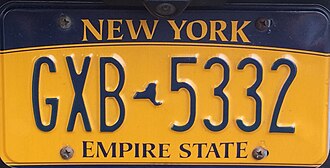
The Empire Gold plate used a gold field, a dark blue banner across the top with the state name in gold, and Empire State in dark blue along the bottom. Plates from that base remain legal as long as their registrations are current, and drivers who still hold one are not required to swap. The change happens when the plate fails, when the car is sold, or when the owner asks for the newer look.
Which Vehicles Take the Excelsior Design
The standard design is issued by registration class rather than by vehicle brand, and the class decides how many plates the car gets and how large they are. A passenger car carries two plates, one on each bumper, and most other classes carry a single rear plate. The table below lines up the common classes a driver is likely to meet.
| Registration class | Plates issued | Notes |
|---|---|---|
| Passenger | Two, front and rear | The usual private car or light truck |
| Commercial | Two, front and rear | Carries a commercial numbering series |
| Motorcycle | One, rear only | A smaller plate size is used |
| Trailer | One, rear only | Issued with the towing registration |
| Personalized passenger | Two, front and rear | Same design with chosen characters |
Class matters, since a plate issued for one class cannot be mounted on another. A motorcycle plate is smaller than a passenger plate, and a commercial plate carries a series that an officer reads as a business registration. Ordering by the class shown on the registration document the first time avoids a return trip to the office.
Timing and Delivery for a New Plate Set
Standard plates for a car registered at an office are often handed over at the counter the same day, and the registration document is printed with the new number on it. A replacement set or a mail order travels by post and takes longer, since the plate is stamped and printed at the production facility before it ships. New York plates are made at Corcraft, the state’s prison industry program at Auburn Correctional Facility, and the embossing and film application happen there. Keep the old plate on the car until the new set is in hand.
Plate Materials and How the Artwork Is Printed
A New York plate starts as a sheet of steel, and the artwork is screened onto reflective film before the characters are embossed through the surface. Embossing raises the number above the face of the plate, which gives a reader a raised edge to catch the light. Screened art has to survive that stamping, so designs use simple shapes and strong edges. Fine lines disappear when the metal is pressed, and a busy image behind the number makes the characters harder to read at speed. The state reserves the right to adjust artwork before production.
The Statue of Liberty Plate and Its Legacy
The red Statue of Liberty plate ran as the standard New York issue from 1986 to 2001, and the figure left an impression that outlasted the base itself. Liberty stood at the center of a white field between two red stripes, with the state name above and the number below. When the state moved to the blue and white design in 2001, the Liberty artwork did not disappear; it shifted onto specialty and organizational plates that the DMV still prints. Those later plates gave the figure a second life on the road.
Specialty Plates That Carried the Liberty Artwork
A specialty plate can pair the Liberty image with a cause, an organization, or a branch of service, and the artwork is reset to fit the design. Some versions show the figure in white against a blue field, and others reduce it to simple line art along one edge. A driver who wants the look of the older base can sometimes find it on one of these designs, though the colors and the position of the figure will differ from the 1986 standard. The availability tool and the plate’s own page confirm which designs are open and whether a chosen number is allowed. Liberty remains one of the most recognized images on any New York plate.
Collectors and the Liberty Design
Collectors value clean Liberty plates from the 1986 to 2001 run, since that base marks the years when the artwork first held the center of the standard series. A plate from that span stays legal on the road as long as the registration behind it is current, and the DMV does not recall it for the artwork alone. An owner who wants to keep the look should protect the plate from peeling, since the reflective film on that generation can lift around the embossed characters. A plate that fails to read can be replaced, and the new set arrives in the current Excelsior design. The old base is not reproduced for standard issue today.
Caring for a Current Excelsior Plate
The current Excelsior plate is a piece of steel under a sheet of reflective film, which means the same care that protects any New York plate applies. Wash it with mild soap, keep abrasive products off the face, and clear winter road salt before it bonds to the surface. The film can lift around the raised characters after several years, and a plate that has lost its sheen reads poorly at night. A driver who notices the surface breaking down should act before a traffic stop forces the issue. The replacement path is simple and the charge is low. Mounting the plate between 12 and 48 inches from the ground and away from the exhaust helps it last.
Replacing a Peeling or Faded Set
A plate that has begun to peel, crack, or fade can be replaced for $25, and the new set arrives in the current design. The DMV does not require a reason for the swap, and a registration that is already active simply gets a fresh pair. Drivers who want to keep their current characters can ask whether those numbers can carry over, since the state has offered that option on past reissues. A replacement follows a lost or stolen plate as well, and a theft should be reported so the old number can be blocked. Keep the old plates off the car once the new set is mounted.
Keeping the New Plate Readable
Keep the plate clear of a frame that hides the state name or any character, since a covered plate gives an officer a lawful reason to pull a car over. New York bars a facsimile plate under section 402-A of the vehicle and traffic law, and the rule applies to a decorative tag as much as to a copy. Wipe the face after a long highway trip, when bugs and dust build up and dull the reflective surface. Check the mounting bolts a few weeks after you install the set, since vibration can loosen them. A readable plate protects the driver at a toll gantry and at a traffic stop.
Reading the Statue of Liberty Plate Today
The red Liberty base holds a clear place in the lineup, and a driver who knows its layout can date a plate at a glance. The white field, the twin red stripes, and the standing figure tell the story before any number is read. Later plates that reuse the figure change the colors and the position, which makes them easy to separate from the standard run. A few details decide whether an older set is still doing its job on the road.
Telling the Red Liberty Base From Later Issues
The standard Liberty plate ran from 1986 to 2001, and it screened the figure in red at the center of a white field, between a red stripe at the top and another at the bottom. The state name sat above the figure and the number sat below it. A specialty design that borrows the image usually shifts the colors, so the figure may appear in white on a blue field or as line art along one edge. The stripes and the centered figure settle the question, and a photo of the plate makes the match simple.
Why the Figure Moved to Specialty Plates
When New York picked a new standard base in 2001, the Liberty artwork did not retire with the old design. The DMV kept the figure for specialty and organizational plates, where it could pair with a cause, a branch of service, or a group. A driver who wants the older look can sometimes find it on one of those plates, though the field color and the placement will differ from the 1986 run. The plate’s own page lists which designs carry the image and whether a chosen number is allowed.
What a Valid Older Plate Needs
An older plate stays legal as long as the registration behind it is current. The film on that generation can lift around the embossed characters after years outdoors, and a plate that stops reflecting light draws the attention of an officer. A clean surface, legible characters, and a mounting height between 12 and 48 inches keep the set in service. A plate that has failed can be replaced for $25, and the new pair arrives in the current Excelsior design. A driver who likes the older base should guard it from peeling, since the state does not print that design for standard issue today.
Frequently Asked Questions
These answers cover the questions drivers ask most often about the Excelsior plate and the Statue of Liberty designs, from what the current artwork shows to how an older base is swapped out for the new one.
What Does the Excelsior License Plate Look Like?
The current plate has a white background with dark blue characters, the state name in dark blue across the top between gold and blue stripes, and the motto Excelsior in gold with a blue outline at the bottom center. Niagara Falls, the Adirondack Mountains, a city skyline, and a Long Island lighthouse run along the lower edge.
Does the Current New York Plate Show the Statue of Liberty?
No. The winning design from the 2019 vote uses Niagara Falls, the Adirondack Mountains, the New York City skyline, and a Long Island lighthouse. The Statue of Liberty belongs to the standard plate issued from 1986 to 2001, where the figure appeared in red at the center of a white plate.
Can I Still Drive With a Statue of Liberty Plate?
Yes. A Liberty plate stays valid as long as the registration behind it is current, and the DMV does not recall a plate just for that reason. The plate comes off when it fails to read, when the vehicle is sold, or when the owner chooses to pay for a replacement set in the current design.
How Do I Get the New Excelsior Plate on My Car?
A new registration, a renewal that calls for fresh plates, or a replacement order all lead to the current design. The set can be requested online, at a DMV office, or by mail, and the $25 plate charge applies. Mount the new plates 12 to 48 inches from the ground and remove the old ones.
What Does the Long Island Plate Show?
The Long Island regional plate places the Montauk Point lighthouse at the center of the design. It is issued to drivers who live in Nassau and Suffolk counties, and it earned a national award for plate design in its year. The lighthouse gives residents a landmark they recognize from a distance.