Empire State is the nickname New York put on its plates for years, and it is the phrase most drivers picture when they think of a New York registration. The slogan ran on the 2001 to 2010 blue and white base, then shortened to Empire State on the gold plate that arrived in 2010. That gold base, called Empire Gold, stayed in production for a decade and remains legal on the road today. Collectors chase clean examples for the color pairing, and drivers still ask how to tell one base from the next.
The gold plate was not the first design to carry the slogan, and it will not be the last. New York used Empire State on earlier issues in the 1950s and 1960s, dropped it for a long stretch, and brought it back in 2001. The 2010 base kept the wording, changed the field from white to gold, and printed the name inside a dark blue banner. The current Excelsior plate retired the nickname in favor of the state motto. A driver can still renew the older base, so both designs share the road.
The Empire State Slogan
New York first screened The Empire State on a standard passenger plate in 1951, and the phrase stayed through the 1963 issue before the state dropped it. The words returned in January 2001 on the blue and white base, where they ran in white letters along a lower blue bar. In 2010 the slogan shortened to Empire State in dark blue at the bottom of the gold plate. The current base ended the run in 2020 by printing the state motto in its place.
Where the Slogan Came From Before 2001
Empire State is a nickname New York adopted in the 1800s, and the plate slogan borrowed it long before the modern designs. The state printed the phrase on standard plates from 1951 through 1963, then let it go during the years when plates carried no slogan at all. The Liberty base that ran from 1986 to 2001 left the bottom of the plate open. When the DMV planned the 2001 replacement, it reached back to the nickname and set the words The Empire State in white on a blue bar. That choice tied the new base to plates drivers had seen decades earlier.
The Empire Gold Design
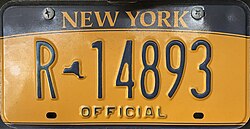
The DMV unveiled Empire Gold in November 2009 and began issuing it on April 1, 2010. The new base returned to the blue and gold pairing the state treats as its own colors, and it used dark blue characters on a gold field. A dark blue banner runs across the top with the state name printed in gold, and the slogan Empire State sits in dark blue across the bottom. The launch was tied to highway safety as much as to design, since the reflectivity of the 2001 base was guaranteed for only about five years.
The Gold Field and Navy Lettering
Gold and navy give the plate its strong contrast, and contrast is what makes a number legible at a distance. The gold field is a warm reflective film that throws light back toward a headlight, and the navy characters stay dark against it. A small dark blue silhouette of New York separates the letter group from the number group, which lets an officer read the two halves at a glance. Embossing raises the characters above the surface, so the number keeps a visible edge even in low light. The pairing is the same one the 1973 orange base used in spirit.
Empire Blue and White, the Base Before It
Empire Gold replaced the plate issued between 2001 and 2010, often called the Empire Blue and White base. That design put dark blue characters on a white field, added a blue bar above and below the number, and set The Empire State in white on the lower bar. The upper bar carried the state name over artwork that showed Niagara Falls, the Adirondack Mountains, and the New York City skyline. Those plates remain valid on the road, and the state called off its plan to replace all of them after drivers objected to the fee.
Peeling and the Free Exchange
Peeling is a failure of the reflective film rather than of the steel underneath. The film bonds to the metal, and a weak bond lets the sheet lift at the edges once moisture and road salt work their way in. The problem shows up around the embossed characters first, since stamping the number stresses the film exactly where it has to hold. Some production runs of Empire Gold were reported to fail earlier than the state expected, with sheets lifting within a few years of issue. A plate with a missing patch can fail an inspection or draw a traffic stop.
The Free Exchange for Failed Plates
The DMV responded to early failures with a free exchange. A driver whose plate peeled soon after issue could bring it in and receive a replacement set at no charge, rather than paying the usual $25. The exchange applied to plates that came apart inside the first few years, and a plate damaged in a crash or a scrape falls outside it. A peeling plate that a driver has carried for a decade is handled as an ordinary replacement.
The rule of thumb is simple: a plate that fails early is the state’s problem, and a plate that fails after years of service is the owner’s. Keeping the plate clean and out of the sun when the car is parked does little to stop a weak film, and no coating or sealer restores a bond that has already let go.
Telling Empire Gold From the Current Design
The two most common bases on the road today are easy to separate once a driver knows where to look. The background and the words at the bottom decide it, and the landmarks settle any doubt. The table below compares them feature by feature.
| Feature | Empire Gold, 2010 to 2020 | Excelsior, 2020 to today |
|---|---|---|
| Background | Gold field | White field |
| Top band | Dark blue banner with the state name in gold | State name in dark blue beside gold and blue stripes |
| Bottom text | Empire State in dark blue | Excelsior in gold with a blue outline |
| Artwork | State silhouette as the divider | Niagara Falls, mountains, skyline, lighthouse |
| Characters | Dark blue, embossed | Dark blue, embossed |
Both bases carry an embossed dark blue number, so the color of the field and the wording at the bottom do the real work. A driver reading a plate in a parking lot can settle the question in a second. A plate with peeling film, a bent edge, or an obscured character needs a replacement no matter which base it started on.
Collecting and Mounting Empire Gold Plates
Clean Empire Gold plates hold a following among collectors, and the reason is the short production window rather than the age. A set issued in the first year of the base and never mounted draws the most interest, followed by low-mileage plates from rural counties. Collectors look for sharp embossing, a full gold field with no lifting film, and an intact slogan line at the bottom. A used plate from a common series is worth little, and a plate that has peeled through the slogan loses most of its appeal. Keep a collected plate indoors, away from damp air and direct sunlight.
Mounting Rules and Display Limits
A plate on a car has to meet a short list of state rules, and those rules decide when a display plate crosses into trouble. The steps below cover the mounting standard, the two-plate rule, the ban on copies, and the safe way to keep a plate as a collectible.
-
Keep the plates 12 to 48 inches high
New York sets the mounting height at 12 to 48 inches from the ground to the bottom of the plate. The rule keeps a plate inside the field a camera and an officer expect to read. A plate tucked under a bumper or raised above the limit gives an officer a reason to stop the car.
-
Leave both plates on a passenger car
A passenger vehicle carries a front plate and a rear plate, and the front one matters as much as the rear in a two-plate state. Driving with a single plate can lead to a ticket even when the rear plate is clean and current. Replace a missing front plate rather than leaving the bracket empty.
-
Keep the surface clear
Frames, tinted covers, and plastic shields can hide a character or cut down on the reflection a camera needs. A cracked or peeling plate fails the same way a covered one does. Clean the characters with a soft cloth and check the edges for lifting film each time the car is washed.
-
Avoid anything that copies a real plate
New York law bans a facsimile plate, which is a copy of a state plate that the DMV did not issue. A novelty plate with the same layout and colors can be mistaken for a real one and is not allowed on a registered vehicle. Keep novelty items off the bumper.
-
Store a collector plate off the car
A plate kept as a collectible does not need to meet the mounting rules, since it never goes on a registered vehicle. Keep it indoors, out of damp air, and handle the edges rather than the face. Never mount a collected plate on a car to avoid paying the $25 replacement charge.
- New York DMV plate replacement and plate types:
- dmv.ny.gov/plates
- Registration and title forms:
- dmv.ny.gov/forms
Empire Gold on the Road Today
A gold plate stays valid as long as the registration behind it is current. New York does not force a driver to trade in a base that still meets the reflectivity standard, so the gold and the white designs sit in the same traffic lane. The plate is retired only when the film lifts, when the number is replaced, or when the owner chooses a new set. A driver who likes the gold look can keep renewing it and pay the same plate fee that applies to any standard design.
Renewing a gold plate
A renewal continues the registration for two years and keeps the plate on the car. The standard fee is $25 for the term, the same figure the state charges for a current base. The DMV checks insurance and inspection before it accepts the payment, exactly as it does for the white plate. The sticker that arrives carries the new end date and no design change. A driver who wants a fresh set in the gold look should know that the design is no longer printed, so a replacement order may return the current base.
When the state asks for a trade-in
New York has occasionally pushed drivers toward a newer base, and the last attempt drew a firm reaction. The state once planned to replace the older blue and white plates and charge owners for the swap. Drivers objected to paying for a change they had not asked for, and the state dropped the mandatory fee. A gold plate has not been recalled in the same way. For now, the choice to keep the design sits with the owner and lasts as long as the film holds.
Buying a car with a gold plate
A car sold with a gold plate usually transfers without the plate, since the number belongs to the seller or to the state record. The buyer registers the car and receives a set in the current design. The gold set comes off at the sale and may be kept as a collectible or surrendered. Confirm who keeps the plate in the bill of sale, and check the title for a brand before any money moves. The plate itself carries no value into the deal beyond the design.
How New York Makes a Plate
The plates on a New York car are stamped and finished inside the state prison system. Corcraft, the manufacturing arm of the corrections agency, runs the operation at Auburn Correctional Facility, and the work gives inmates a trade they can carry past release. The shop produces the standard bases, the specialty series, and the personalized sets the DMV orders. A driver rarely thinks about where a plate is born, yet the process explains why a set takes time to reach the mailbox and why a special design costs more.
The Corcraft shop at Auburn
Corcraft supplies plates to the DMV under the state’s own manufacturing program, and the shop follows the same design sheets the agency publishes. The facility handles the steel blanks, the reflective film, and the printed layers that give a plate its colors. With the work in one place, a run of one design can pause as another series takes the line. That schedule sits behind the wait a driver sees after ordering a personalized or picture plate. The state treats the shop as both a supplier and a work program.
Silkscreen and embossing
A plate starts as a flat steel blank coated with a reflective film. A silkscreen pass lays down the background art, the banner, and the slogan in their own inks. A press then stamps the characters from behind, which raises them above the surface and presses the film into the shape. A final coat seals the face and the edges. The mix of print and raised metal is what lets a headlight throw the number back at a driver or a camera on a dark road.
Reading wear on a plate
Wear shows first where the press stressed the film, which is around the raised characters. Small lifts at those edges spread outward as moisture and road salt work under the sheet. A plate kept outdoors on a salty road ages faster than one parked in a garage, and a plate struck by a stone may lose a patch in a single hit. Check the embossed area and the slogan line when you wash the car, and order a replacement once a character grows hard to read.
Plate Numbers Across the Empire Gold Years
The gold base carried more than a slogan. It arrived with a numbering plan that set the letters and the digits in a fixed order, and the design kept a divider that split the two groups. A driver who swaps to a newer base can often keep the same characters, since the number belongs to the registration rather than to the metal. A few rules decide which plates keep their numbers and which ones get a fresh set.
How the Number Series Changed With the Base
New York runs several plate series at once, and each base is fed from the same pool of letter and digit shapes. The standard passenger series prints three letters followed by four numbers, and a second series prints five numbers followed by two letters. The gold base used a small silhouette of the state to divide those groups, which helped an officer read the plate at a distance. A change of base did not change the underlying shapes, so the numbers moved from one design to the next.
Carrying a Number to a New Base
A driver who requests a fresh set in the current design can ask whether the existing characters can travel with the registration. The state has offered that carry-over on past reissues, and it keeps the plate familiar as the artwork changes. The request goes through the same replacement path as any new pair, and the $25 charge applies. Not every series allows a move, so the answer depends on the plate type and the class shown on the registration. Confirm the option before the order is filed.
What the Gold Base Did Not Change
The shift from the blue and white base to the gold one kept the two-plate rule, the mounting height, and the registration term. A passenger car still carries a plate on each bumper, the plates still sit 12 to 48 inches from the ground, and the registration still runs two years. The replacement charge held at $25, and the renewal figure stayed the same. The design changed, and the rules behind it did not. A driver moving from one base to the next follows the same steps either way.
Frequently Asked Questions
These answers cover the questions drivers ask most often about the Empire Gold and Empire State plates, from when the base was issued to why some sets peeled and what a clean plate is worth today.
What Does the Empire Gold Plate Look Like?
Empire Gold uses a gold field with dark blue characters and a small dark blue silhouette of New York dividing the letters from the numbers. A dark blue banner runs across the top with the state name in gold, and Empire State appears in dark blue along the bottom. It was issued from 2010 to 2020.
When Did New York Stop Issuing Empire Gold Plates?
The DMV stopped issuing the base in 2020, when the Excelsior design arrived after the 2019 public vote. Empire Gold had been in production since April 1, 2010, which gave it a ten-year run. It replaced the Blue and White base and was itself replaced by the current white design.
Are Empire Gold Plates Still Valid?
Yes. A gold plate stays valid as long as the registration behind it is current, and the state does not require a driver to trade it in. The plate is replaced when the film peels, when the car changes owners, or when the owner chooses to pay $25 for a set in the current design.
Why Did Some Empire Gold Plates Peel?
The reflective film lost its bond with the steel, and moisture and road salt lifted the sheet at the edges. Failure started around the embossed characters, where stamping stresses the surface. Some runs failed within a few years, and the DMV offered a free exchange for plates that came apart early.
Is an Empire Gold Plate Worth Anything to Collectors?
A clean, unmounted set from the first year of the base draws the most interest, and sharp embossing with a full gold field adds to the value. A common used plate is worth little. A plate that has peeled through the slogan line loses most of its collectible appeal, since the wording is part of the design.