New York issues a wide range of license plates, and the design on your bumper depends on who you are, what you drive, and what you want the plate to say. The Department of Motor Vehicles sorts plates into families: standard passenger, personalized, custom picture, professional, military, disability, historical, motorcycle, and commercial. Each family carries its own rules, price, and application path. Knowing which family fits your vehicle helps you choose the right form the first time and avoid a rejected order. A new registration and a plate swap both begin with the same paperwork, so the family you pick shapes the fee you pay.
Every plate that leaves a DMV office is produced at Corcraft, the manufacturing arm of the New York State Department of Corrections, at Auburn Correctional Facility. That single production point keeps designs consistent across the state. A standard passenger plate costs $25 to buy and $25 to renew, and custom or specialty designs carry their own prices. Registration runs for two years, and the plate stays with the owner rather than the car. This summary walks through each plate family and what a driver needs to know before placing an order.
How the DMV Assigns Plate Types
The plate on your vehicle follows the registration class, not the color or brand of the car. When you register a vehicle with form MV-82, the clerk enters the class, and the system prints the plate family that matches it. A passenger car draws a standard plate until you ask for something else. A truck, a motorcycle, or a trailer draws a class-specific plate. The facts below show how the main families line up, what each one costs, and where the order starts.
Standard and Personalized Plates
The standard passenger plate is the blue and gold Empire State design that most drivers picture. It arrives with a new registration or replaces a worn plate on an existing one. A passenger registration covers cars and light trucks used for personal travel. The plate carries a three-letter and four-number combination, and the state keeps that series consistent from year to year. You do not choose the characters on a standard plate without paying for a personalization.
- Register the vehicle
Complete form MV-82 and bring proof of ownership, insurance, and identity to a DMV office. The clerk assigns a registration class and hands over a plate. First-time registrations usually receive a new standard plate at the counter.
- Pay the plate fee
A standard plate costs $25 to buy. That charge is separate from the registration fee for the two-year period, so bring payment for both and finish the transaction in a single visit. Keep the receipt with the registration documents.
- Mount the plate
Attach the plate with the mounting holes the factory provides. New York requires the plate to sit between 12 and 48 inches from the ground and to stay readable. A frame that covers any letter or the state name can draw a ticket.
- Renew on schedule
Passenger registrations run for two years. The renewal notice lists the $25 plate fee when the state issues a new set. Keep the mailing address current with the DMV so the notice reaches you on time.
- Replace a damaged plate
A bent, faded, or peeling plate costs $25 to replace. Hand in the old plate when the new one arrives. Facsimile plates are banned under VTL 402-A, so never order a copy from a private seller.
- Surrender plates you no longer use
When you sell a car or cancel insurance, return the plate to a DMV office or mail it with form PD-7. A surrendered plate closes the registration record and ends your responsibility for it at no charge.
- New York registration and plates:
- dmv.ny.gov/registration-and-title
- Applications and plate forms:
- dmv.ny.gov/forms/mv82.pdf
Personalized and Vanity Plates
A personalized plate lets you pick the letters and numbers, within limits. The DMV accepts most blends of letters, numbers, and spaces, and it blocks anything that could confuse a reader or look like an official plate. Personalization costs $31.25 to $62.50 each year, added to the registration charge. The wording stays with you as long as you renew, and the state can recall it later if a combination becomes offensive or clashes with a new series. A free availability check comes before any payment.
Custom, Specialty and Professional Plates
You can order a custom picture plate for $60 with a number the state assigns, or $91.25 with a number you choose, and an annual fee joins the registration bill. The catalog covers causes, sports teams, colleges, and professions. Orders often travel by mail on form CP-30 when a design needs supporting papers, and common designs can be requested at a DMV office or online. Every design is printed on the same stock at Corcraft.
| Plate family | What you choose | Fee note |
|---|---|---|
| Standard passenger | No choice of characters | $25 to buy, $25 to renew |
| Personalized | Your own letters and numbers | $31.25 to $62.50 each year |
| Custom picture, assigned | A design, with a state number | $60 plus the yearly fee |
| Custom picture, personalized | A design and your characters | $91.25 plus the yearly fee |
| Professional | A job or group credential | Varies with the design |
| Military and veteran | Proof of service | Often no added plate fee |
| Historical | A vehicle 25 years or older | Charged with the registration |
Price is not the only gap between an assigned and a personalized custom plate. An assigned plate often arrives faster, since the state controls the number series. A personalized order waits on a review of the characters. Both versions keep the design you selected for as long as the registration stays active and you keep renewing. If you drop the registration, the plate returns to the state, and the design can be issued to another driver.
Professional Plates
Professional plates tell other drivers about a job or a credential. New York offers designs for certain licensed trades, health workers, and public employees, each tied to a group that confirms membership. An applicant usually shows a card, a letter, or a membership number with the order. These plates carry the standard registration charge and, in many cases, an annual fee for the design. Since eligibility sits with the sponsoring group, the DMV checks the request against the group’s list before printing.
Honor, Disability and Historic Plates
Military and veteran plates honor service in the armed forces. Designs mark branches such as the Army, Navy, Air Force, Marines, and Coast Guard, and some recognize a campaign or a medal. An applicant submits proof of service, often a DD-214 or a current military ID, with the order. Most of these plates carry no extra charge beyond the standard registration fee. A veteran can ask about a plate tied to a branch or a unit, subject to the records the state keeps.
Disability Plates
Disability plates show the international wheelchair symbol on the plate face. They allow parking in reserved spaces and come with a matching permit for use in any vehicle that carries the driver. A doctor completes the medical section of the application, and the DMV issues the plate once the form is on file. There is no separate plate charge, only the standard registration fee. The permit and the plate are linked, and both are renewed when the medical certification expires.
Historical and Vintage Plates
Historical plates mark a vehicle that is at least 25 years old. The state offers a standard historical design and a year-of-manufacture option, where a plate from the car’s model year is approved for display. Historic vehicles face limits on how they are driven, and inspection follows a lighter schedule than a daily driver. A collector who wants to show a period-correct plate submits the old plate for review. More detail on the program sits on the historical plate page.
Vehicle-Class and Regional Plates
A motorcycle carries one plate on the rear. The plate is smaller than a passenger plate and fits the bracket the factory installs. Registration falls under class M, and the same two-year cycle applies. Personalizing a motorcycle plate follows the same review as a car plate, though the smaller face limits how many characters fit. Riders should keep the plate clear of the exhaust and the tire so it stays readable and legal.
Commercial and Trailer Plates
Commercial plates cover trucks, buses, and vehicles used in business, and each plate carries a class code that reflects weight and use. Trailers get their own plate, and most trailers need only a rear plate. A commercial registration costs more than a passenger one and follows weight limits the DMV checks at the counter. Dealers and repair shops use their own series, each numbered to the business. The photo below shows a commercial design on a working truck.
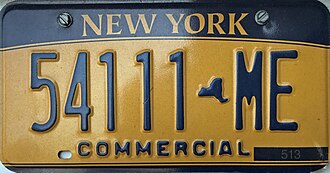
Match the plate class to the job. A light delivery van and a heavy box truck can fall into different weight classes, and the plate and fee move with the class. A trailer pulled behind a passenger car still needs its own registration and plate. When a business sells a truck, the plate is surrendered with form PD-7 so the record closes. Ordering a commercial plate happens at a DMV office, where the clerk confirms the weight and use.
Regional Designs and Statewide Choices
New York issues the standard statewide design to every passenger vehicle, so a plate bought in Buffalo looks the same as one bought in Brooklyn. Where the state does vary is in the catalog of specialty designs, which includes artwork tied to regions, teams, and landmarks. A driver who wants a plate that reflects a hometown can look through that catalog and order the design that fits. The base passenger plate stays the same no matter where the vehicle is registered.
Choosing the Right Plate Family
Pick the family before you fill in a form. The registration class on form MV-82 sets the plate the DMV can issue, and a request that crosses families stalls at the counter. A passenger car, a light pickup, and a motorcycle each draw a different tag. The points below help a driver match a plate to a vehicle and a budget without a second visit to the office.
Match the Plate to the Registration Class
The clerk reads the class on the registration record and offers only the plate families that belong to it. A passenger car can take a standard, personalized, or custom picture plate. A motorcycle carries the smaller class M tag on the rear. A commercial truck takes a class code tied to its weight and its use. Ask the clerk to read back the class before you choose a design, since a plate bought for the wrong class cannot be used and the fee is not returned.
Set a Budget Before You Order
A standard plate at $25 is the lowest cost, and a personalized set runs $31.25 to $62.50 each year. A custom picture plate costs $60 with an assigned number or $91.25 when you pick the characters, plus a yearly fee. A specialty design may add a donation that the sponsoring group sets. Add the two-year registration charge of $31.25 or $62.50, and a first visit can pass $150. Write the total down so the counter figure holds no surprise.
Check Eligibility for a Restricted Design
Some designs belong to a group rather than to the public. A professional plate asks for a license or a membership card, a military plate asks for proof of service such as a DD-214, and a disability plate asks for a doctor’s signature on the medical section of the application. A regional design may ask for proof of residence. Gather that paper with the registration form, since the DMV checks the request against the group’s list before it prints the tag.
Ordering, Delivery and Renewal Timing
Most plate orders move through one pipeline once the paperwork clears. The DMV records the request, Corcraft prints the steel at Auburn Correctional Facility, and the tag arrives by mail. Where the paths differ is the paper that starts them: a counter visit for a standard or personalized plate, and often a mailed form CP-30 for a custom picture design that needs supporting papers. Plan the timing around your registration expiration so the old plate stays legal until the new one is bolted on.
How an Order Travels Through the System
A standard plate is often handed over at the counter, since the office keeps a stock of common series. A personalized or custom design is made to order, so the office forwards the request and the printed tag follows in the mail. A design that needs a membership or a service record waits until that paper lands in the file. Delivery runs several weeks in a normal season, and a busy one adds time. Keep the old plate on the vehicle until the new one arrives.
Timing the Order Around a Renewal
A two-year registration gives a driver a natural moment to change a plate. Order the new design a month or two before the expiration date so both the registration and the tag arrive together. If you order after the renewal, the office can still swap the plate, and the old set comes back to the DMV. A plate dropped mid-term does not shorten the registration charge, so align the switch with the date on the notice when you can.
What Happens When a Design Is Delayed
A delay rarely leaves a driver without a legal plate. The registration stays active, and the old tag serves until the replacement is mounted. If the old plate is lost or damaged in the meantime, a replacement costs $25 and carries the same number in most cases. Report a stolen plate to police and file form MV-78B so the DMV can block the number. A driver who sells the car before the new design arrives can move the order to the next vehicle or surrender the plate with form PD-7.
Plate Care and Common Problems
A plate faces salt, sun, and spray every day it sits on a bumper. New York bonds reflective film to steel, and that film is the part that fails first. A plate that peels, bends, or loses a mounting bolt reads poorly to an officer and to a toll camera. A few habits keep the tag readable through a two-year term and spare the $25 replacement charge.
Cleaning and Mounting the Plate
Wash the plate with mild soap and water, then dry it with a soft cloth. Skip abrasive pads and solvents, since they lift the reflective film and take the printed artwork with it. Mount the tag with the factory holes and check that it sits between 12 and 48 inches from the ground. A frame that covers a character, the state name, or the small state silhouette can draw a ticket, so choose one that leaves the whole face open. Tighten the bolts after a rough road.
When to Ask for a Replacement
A bent, cracked, or peeling plate should be replaced rather than straightened or repainted. The DMV charges $25 for a replacement set and issues the same characters when they are free. A peeling plate that fails early can qualify for a free exchange, so keep the receipt and ask about the policy. Never order a copy from a private seller, since a facsimile plate is banned under section 402-A of the vehicle and traffic law. Hand in the old set when the new one arrives.
Frequently Asked Questions
Drivers ask the same few questions about plate families. The answers below cover the gap between a standard and a custom plate, who can order a professional or military design, how long a personalized combination lasts, and what happens when a plate is lost or damaged. Each answer follows current New York DMV practice.
How much does a standard New York plate cost?
A standard passenger plate costs $25 to buy and $25 to renew. That charge sits on top of the registration fee, which runs for two years at $31.25 or $62.50 based on the vehicle weight class. A replacement plate for one that is lost, stolen, or damaged costs $25. The clerk collects the plate fee when the registration is issued.
What is the difference between a personalized plate and a custom picture plate?
A personalized plate lets you choose the letters and numbers for $31.25 to $62.50 each year. A custom picture plate adds an image, such as a team logo or a cause. An assigned custom picture plate costs $60, and a personalized custom picture plate costs $91.25, with an annual fee on top. A driver can blend both features to get artwork and chosen characters.
Who can order a professional plate?
Professional plates are tied to a job, a license, or a group the state recognizes. An applicant shows proof of membership or a credential when ordering, and the DMV checks the request against the sponsoring group’s list. The plate carries the standard registration charge, with an annual design fee in many cases. A driver who leaves the group may need to return the plate.
How long does a personalized combination stay in my name?
A personalized combination stays with you as long as the registration stays active and you renew on time. The state can recall a combination later if it becomes offensive or clashes with a new series. If you let the registration lapse, the wording returns to the pool and another driver can request it. Renewing before the expiration date keeps the plate in your name.
What should I do if my plate is stolen?
Report the theft to police and file form MV-78B, the police report for stolen items. The DMV then blocks the old plate so it cannot be used. You can order a replacement for $25 and, in most cases, keep the same characters. Surrendering a plate you no longer use takes form PD-7. Never buy a copy of a plate from a third party, since facsimile plates are banned under VTL 402-A.